
BMI Calculator
Use our free BMI Calculator to quickly calculate your Body Mass Index (BMI) using your height and weight. Enter your details to get your BMI result and understand which BMI category your result falls into.
BMI Calculator
Enter your height and weight to calculate your Body Mass Index (BMI).
Your BMI
0.0
Category
-
More Calculator Tools
Need more help with everyday calculations? Explore our free calculator tools to calculate time, dates, numbers, finance, and other useful values. Choose the calculator you need and get accurate results in just a few clicks.
Percentage Calculator
Percentage Increase Calculator
Percentage Decrease Calculator
Discount Calculator
Age Calculator
BMI Calculator
Loan Calculator
Mortgage Calculator
Compound Interest Calculator
Simple Interest Calculator
Profit Margin Calculator
Markup Calculator
Tip Calculator
GPA Calculator
Grade Calculator
Grade Calculator
How to Use the BMI Calculator
Using the BMI Calculator is simple:
1- Enter your weight.
2- Enter your height.
3- Click the Calculate BMI button.
4-Your BMI result will be displayed instantly.
5- Check the BMI category associated with your result.
The calculator is designed to make BMI calculations quick and easy without requiring manual calculations.
What Is BMI?
BMI, or Body Mass Index, is a measurement calculated using a person’s weight and height. It is commonly used as a screening measure to help classify weight status in adults.
BMI is calculated by comparing body weight with height. However, BMI does not directly measure body fat and does not account for factors such as muscle mass, bone density, age, or body composition.
For this reason, BMI should be considered as one general measurement rather than a complete assessment of overall health.
For a detailed definition, see Wikipedia’s Body Mass Index page.
BMI Formula
The standard BMI formula for adults using kilograms and meters is:
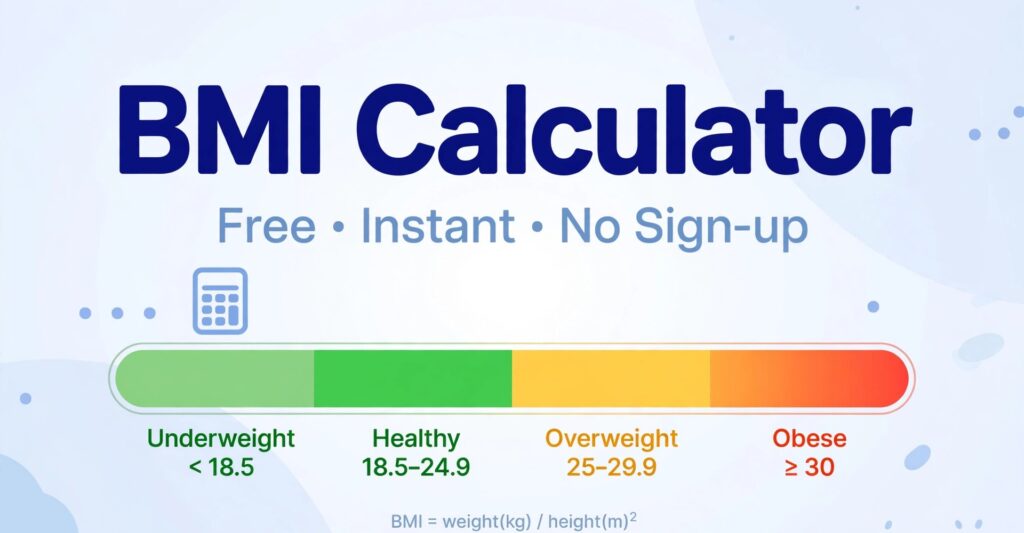
BMI = Weight (kg) ÷ Height² (m²)
For example, if a person weighs 70 kg and is 1.75 meters tall:
BMI = 70 ÷ (1.75 × 1.75)
BMI = 22.86
The BMI Calculator performs this calculation automatically, so you do not need to calculate it manually.
BMI Categories for Adults
For adults, BMI is commonly grouped into the following categories:
| BMI Range | Category |
|---|---|
| Below 18.5 | Underweight |
| 18.5 – 24.9 | Healthy weight |
| 25.0 – 29.9 | Overweight |
| 30.0 or higher | Obesity |
These categories are general screening ranges for adults. They are not intended to diagnose a medical condition.
BMI Example
Suppose your weight is 80 kg and your height is 1.80 meters.
The calculation would be:
BMI = 80 ÷ (1.80 × 1.80)
BMI = 24.69
A BMI of approximately 24.69 falls within the commonly used healthy-weight range for adults.
Your actual BMI can be calculated instantly by entering your height and weight into the calculator above.
BMI Formula in Pounds
The calculator above uses kilograms and centimeters. If you know your weight in pounds and your height in feet and inches, use the imperial formula: BMI = 703 × Weight (lb) ÷ Height (in)².
For example, a person who weighs 154 lb and is 5 ft 9 in tall (69 inches) has a BMI of 703 × 154 ÷ 69² = 22.7. To use the calculator above instead, convert first: 1 lb = 0.4536 kg and 1 inch = 2.54 cm.
What Is My Ideal Weight?
Your ideal weight is the weight that keeps your BMI in the healthy range of 18.5 to 24.9. Multiply 18.5 and 24.9 by your height in meters squared to find your range.
For example, if you are 1.75 meters tall, your healthy weight range is about 56.7 to 76.3 kg. This BMI Calculator does not show an ideal weight range, so use this calculation to find yours.
Is BMI the Same for Men and Women?
Yes. The formula and the adult BMI categories are the same for men and women. What differs is body composition: for the same BMI, women on average carry more body fat than men, and men on average carry more muscle.
For example, a woman who is 5 ft 2 in (1.575 m) tall and weighs 60 kg has a BMI of 24.2, which is in the healthy-weight range.
Why Calculate Your BMI?
Calculating BMI can be useful for getting a general understanding of your weight in relation to your height.
People may use a BMI calculator for:
General health awareness
Fitness and weight-management tracking
Monitoring changes in body weight
Setting personal fitness goals
Preparing for a conversation with a healthcare professional
Quickly checking BMI without doing manual calculations
BMI can be useful as a starting point, but it should not be used by itself to determine whether someone is healthy.
BMI and Weight Management
BMI can provide a simple reference point when tracking changes in body weight over time.
For example, if your weight changes significantly, your BMI will also change. Tracking BMI alongside other measurements can help you understand how your weight changes in relation to your height.
However, factors such as diet, physical activity, muscle mass, waist circumference, and overall health can provide additional information that BMI alone cannot show.
Is BMI Accurate for Everyone?
BMI is a useful screening measurement, but it has limitations.
For example, BMI does not distinguish between muscle and fat. A person with a high amount of muscle may have a higher BMI even though they have a relatively low body-fat percentage.
BMI may also not provide an appropriate interpretation for certain groups, including children, teenagers, pregnant people, and some athletes.
If you have questions about what your BMI means for your individual health, consider discussing your result with a qualified healthcare professional.
BMI for Children and Teenagers
Adult BMI categories should not be applied in the same way to children and teenagers.
For people under 18, BMI interpretation generally takes age and sex into account and is assessed using age-specific growth charts or percentiles.
Therefore, this calculator should be used as a general adult BMI calculator unless it specifically states otherwise.
BMI vs. Body Fat Percentage
BMI and body fat percentage are different measurements.
BMI uses height and weight to provide a general weight classification.
Body fat percentage estimates how much of your total body weight consists of fat.
Because BMI does not directly measure body fat, two people can have the same BMI while having different body compositions.
For a more complete understanding of body composition, additional measurements may be useful.
What Does a BMI Number Mean?
A BMI number provides a general indication of how a person’s weight compares with their height.
For example:
A BMI below 18.5 is generally classified as underweight.
A BMI from 18.5 to 24.9 is generally classified as healthy weight.
A BMI from 25 to 29.9 is generally classified as overweight.
A BMI of 30 or above is generally classified as obesity.
These categories are screening classifications and should not be interpreted as a diagnosis.
Benefits of Using an Online BMI Calculator
An online BMI calculator can save time and reduce the need for manual calculations.
Quick Calculation
Enter your height and weight to get your BMI result within seconds.
Easy to Use
The calculator is designed with a simple interface that does not require technical knowledge.
No Manual Formula
You do not need to remember or calculate the BMI formula yourself.
Free Online Tool
You can calculate your BMI online without installing additional software or applications.
Useful for Tracking
You can use your BMI result as one measurement when tracking changes in your weight over time.
When Should You Calculate Your BMI?
There is no need to calculate BMI repeatedly throughout the day because your height remains relatively stable and your weight does not normally change significantly within a short period.
You may choose to calculate BMI when:
You want a general weight-to-height measurement.
You are starting a fitness or weight-management routine.
You want to track changes in your weight.
You want information to discuss with a healthcare professional.
For consistent tracking, using measurements taken under similar conditions can make comparisons more meaningful.
Important BMI Limitations
BMI should not be considered a complete measure of health.
It does not directly measure:
Body fat percentage
Muscle mass
Bone density
Fat distribution
Overall fitness
Diet quality
Medical conditions
A BMI result is therefore best viewed as a general screening measurement rather than a diagnosis.
Frequently Asked Questions
A BMI calculator is an online tool that calculates Body Mass Index using a person's height and weight.
BMI is calculated by dividing weight in kilograms by height in meters squared.
BMI = Weight (kg) ÷ Height² (m²)
For adults, a BMI from 18.5 to 24.9 is commonly classified as the healthy-weight range. BMI is only a screening measure and does not provide a complete assessment of health.
For adults, a BMI of 25.0 to 29.9 is commonly classified as overweight. However, BMI does not account for muscle mass or other factors that can affect body composition.
No. BMI is calculated from height and weight, while body fat percentage estimates the proportion of your body weight that is fat.
Yes. You can use the formula:
BMI = Weight (kg) ÷ Height² (m²)
However, an online BMI calculator makes the calculation faster and reduces the chance of mathematical errors.
Adult BMI categories are not generally used to interpret BMI in children and teenagers in the same way. Their BMI is usually interpreted according to age and sex using appropriate growth charts.
BMI can provide a general screening measurement, but it cannot determine your overall health by itself. Other factors should also be considered.
Yes. BMI does not distinguish between muscle and fat. People with substantial muscle mass may have a higher BMI even when they have relatively low body fat.
Yes. You can use this BMI Calculator online for free to calculate your BMI quickly.
The imperial formula is BMI = 703 × Weight (lb) ÷ Height (in)². For example, 154 lb at 5 ft 9 in (69 inches) gives a BMI of 22.7. The calculator above uses kilograms and centimeters only.
Your ideal weight is the weight that keeps your BMI between 18.5 and 24.9. For a height of 1.75 meters, that is about 56.7 to 76.3 kg. Multiply 18.5 and 24.9 by your height in meters squared to find your own range.
No. The formula and the adult BMI categories are the same for men and women. What differs is body composition: for the same BMI, women on average carry more body fat than men, and men on average carry more muscle.
The calculator does not ask for your age, and the adult BMI categories are the same at any adult age. For children and teenagers, BMI is interpreted differently, using age and sex percentiles on growth charts. You can also check your age with the Age Calculator.
The healthy BMI range of 18.5 to 24.9 is the same for women as for men. For example, a woman who is 5 ft 2 in tall and weighs 60 kg has a BMI of 24.2, which is in the healthy-weight range.
A BMI of 22.9 is in the healthy-weight range of 18.5 to 24.9. For example, a person who weighs 70 kg and is 175 cm tall gets a BMI of 22.9 from the calculator above.
Calculate Your BMI Online
Use the BMI Calculator above to calculate your Body Mass Index using your height and weight. The tool provides a quick result that you can use as a general reference when tracking your weight.
Remember that BMI is only one measurement and should not be used as a substitute for professional medical advice.